Cerebral Palsy
Cerebral palsy is often caused before or during birth as a result of the baby being deprived of oxygen. However, it can be caused by an illness or accident later in life which results in the brain receiving depleted oxygen levels. This results in involuntary muscle spasms due to the brain cerebrum damage. It is a chronic long-term condition [1].
The condition can be defined using two overlapping methods; the body part involved and the type of movements made.
Type of Movement:
- Spastic – This is the most common type. Movement is limited by one or multiple stiff muscle groups resulting in stiff and jerky movements.
- Athetoid – Hyptonia, poor (floppy) muscle tone.
- Ataxic – Poorly coordinated movements and low muscle tone.
- Mixed – A combination of the above.
Body Part Involvement:
- Hemiplegia – One arm and one leg on the same side of the body are affected
- Diplegia – Predominantly both legs are affected with some movement in the arms
- Quadriplegia – All four limbs are affected
Currently there is no cure for cerebral palsy and treatments are aimed at lessening symptoms.[1] Lifetime costs of caring for an individual with cerebral palsy were estimated at nearly $1 million (AED 3,672,500) in 2003, which, adjusted for inflation, is over $1.6 million (AED 5,876,000) as of 2025.[2]
Cerebral Palsy Facts
- It is the most common disability in childhood[3]
- 60% of all children born with it are born at term[3]
- Half of people living with the condition live in chronic pain[3]
- It affects 17 million people globally[3]
- In most cases, brain injury leading to the condition occurs in pregnancy[3]
- Cerebral palsy (CP) prevalence in Arab-speaking countries is estimated at around 1.8 per 1,000 live births, ranging from 0.62 to 3.6 per 1,000 live births depending on the country and study[4]
Around 59.8% of children with CP have spastic cerebral palsy, making it the most common form of the condition in the region[4]
Approximately 37.7% of children with CP were born to parents in consanguineous (related) marriages, reflecting higher rates of intrafamilial marriage in some Arab societies[4] - For every 100 girls with cerebral palsy, there are 135 boys with cerebral palsy[5]
- Approximately a quarter of children with the condition are reported to have epileptic seizures[5]
Cerebral Palsy and Cord Blood Stem Cells
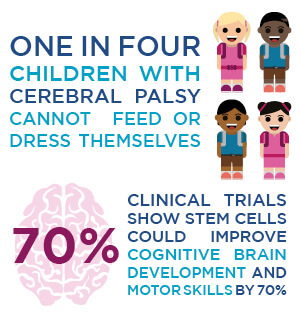
There are currently 29 clinical trials investigating the application of stem cells in cerebral palsy [6]. Clinical trials using cord blood stem cells to treat the condition have had some very exciting results.
One study in South Korea used allogeneic cord blood to treat participants. The study was the first of its kind to publish its findings which showed cord blood had made dramatic improvements in movement, brain development and cognition.
Possibly the most publicised trials for treating cerebral palsy using cord blood stem cells are those headed by Dr. Joanne Kurtzberg of Duke University. The team at Duke have used cord blood infusions in the treatment of brain injuries and cerebral palsy. Within a year, children who received one intravenous dose of at least 25 million cells per kilogram of body weight saw significant improvements in motor function compared to those in the placebo group.[7]
The success of the trials at Duke has enabled Kurtzberg and her team to secure a $15 million (AED 55,087,500) grant to explore and research the potential of cord blood in treating an array of brain disorders.
Our releases
In 2018, Cells4Life released our first cord blood sample for the treatment of cerebral palsy.
The sample belonged to the Shetty family, who hoped to use their second child’s cord blood to treat their first, Jay.
Jay suffers from a debilitating form of cerebral palsy that means he cannot walk, talk, or even sit unaided. He is now taking part in the Duke University trial.
References
- https://www.cdc.gov/cerebral-palsy/about/
- https://cerebralpalsyguidance.com/cerebral-palsy/living/costs/
- https://www.cerebralpalsyfoundation.org/understanding-cerebral-palsy/
- Mushta, S. M., King, C., Goldsmith, S., Smithers-Sheedy, H., Badahdah, A. M., Rashid, H., Badawi, N., Khandaker, G., & McIntyre, S. (2022). Epidemiology of Cerebral Palsy among Children and Adolescents in Arabic-Speaking Countries: A Systematic Review and Meta-Analysis. Brain sciences, 12(7), 859. https://doi.org/10.3390/brainsci12070859
- http://www.thepacecentre.org/Groups/211054/Stats_And_Facts.aspx
- https://clinicaltrials.gov/ct2/results?term=stem+cells+cerebral+palsy&Search=Search
- https://corporate.dukehealth.org/news-listing/umbilical-cord-blood-improves-motor-skills-some-children-cerebral-palsy
- https://doi.org/10.1002/sctm.20-0470
- https://doi.org/10.1186/s12883-022-02636-y
The information contained in this article is for information purposes only and is not intended to replace the advice of a medical expert. If you have any concerns about your health we urge you to discuss them with your doctor.