Multiple Sclerosis and Stem Cells
Multiple sclerosis is an autoimmune disease which affects the nervous system. An autoimmune disease occurs when the body’s immune system attacks healthy cells; in the case of MS, nerve cells are attacked. These attacks damage the myelin coating on the nerves, sometimes until the nerves themselves become damaged. Myelin is an insulating coating which allows signals to be communicated between nerves effectively, much like how the insulation on an electrical wire allows electricity to travel between the plug and appliance.
Like most autoimmune diseases, MS is more prevalent in women than men. People of Northern European descent have the highest risk of developing MS, no matter where they live.[1]
In some countries in the Middle East and North Africa (MENA) region, the cost of caring for a person with MS exceeds the average annual income generated per person, underlining the disease’s significant economic impact.[2]
Multiple Sclerosis Facts
- MS is approximately three times more common in women than in men[1]
- The Middle East and North Africa (MENA) region has seen a rise in cases in recent years, reflecting global trends.[2]
- Fewer than 5,000 children and teens in the United States live with MS[3]
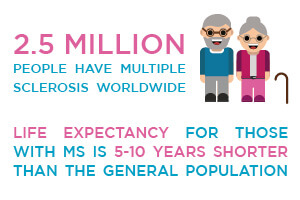
- 2.5 million people live with MS worldwide [4]
- Early MS symptoms are generic making it hard to diagnose [5]
- No single test to prove or disprove MS diagnosis [5]
- Life expectancy for those with MS is 5–10 years shorter than the general population [6]
Multiple sclerosis and Stem Cells
There are currently 193 clinical trials investigating the application of stem cells in multiple sclerosis. [7]
A recent international study has even suggested that stem cells could stop MS by wiping out patients’ immune systems using chemotherapy, before rebuilding them with a stem cell transplant. In a test of 50 people, the transplant failed in just 6% of patients as opposed to failure in 60% of the control group who received standard treatment.
A similar, small preliminary study published in the Journal of the American Medical Association has suggested stem cells may be able to reverse MS. The study took haematopoietic stem cells from the blood of patients participating in the trial and stored them while they received low-doses of chemotherapy drugs. Dr. Richard Burt who headed the study described the process as turning down the patients’ immune-system activity. The stem cells were then re-infused into the patients via their blood.[8]
Of the patients who were followed for four years, 80% remained free of a symptom flare up. Burt has said that further randomised studies are needed to understand if the stem cells administered in the therapy are “resetting” the patients’ immune systems.[8]
Another study has found that placental cells were safe to use and that preliminary evidence suggests that they may be able to contribute to the repair of damaged nerve tissues in MS patients. The study’s lead author, Dr. Fred Lublin, said “We’re hoping to learn more about how placental stromal cells contribute to myelin repair. We suspect they either convert to a myelin-making cell, or they enhance the environment of the area where the damage is to allow for natural repair. Our long-term goal is to develop strategies to facilitate repair of the damaged nervous system.”[9]
The study is the first of its kind to test stem cells derived from the placenta as a possible treatment for MS.
References
- https://www.healthline.com/health/multiple-sclerosis/facts-statistics-infographic
- Batran, R. A., Kamel, M., Bahr, A., Waheb, J., Khalil, A., & Elsokary, M. (2024). Multiple sclerosis: economic burden, therapeutic advances, and future forecasts in the Middle East and North Africa region. Expert Review of Pharmacoeconomics & Outcomes Research, 24(8), 873–882. https://doi.org/10.1080/14737167.2024.2364832
- https://www.nationalmssociety.org/understanding-ms/what-is-ms/who-gets-ms/pediatric-multiple-sclerosis
- http://www.ms-uk.org
- http://www.nationalmssociety.org/What-is-MS/MS-FAQ-s
- http://www.nhs.uk/Conditions/Multiple-sclerosis/Pages/Introduction.aspx
- https://clinicaltrials.gov/ct2/results?term=stem+cell+ms&Search=Search
- http://www.newsmax.com/Health/Health-News/multiple-sclerosis-MS-stem/2015/01/20/id/619645/
- http://multiplesclerosisnewstoday.com/2015/05/05/promising-new-therapy-multiple-sclerosis-based-placenta-cells/
- https://doi.org/10.1016/S1474-4422(11)70305-2
- https://doi.org/10.1001/jama.2018.18743
The information contained in this article is for information purposes only and is not intended to replace the advice of a medical expert. If you have any concerns about your health we urge you to discuss them with your doctor.